
Doctor of Business Administration (DBA)
The Doctor of Business Administration (DBA) is a 3–5-year program
designed to equip experienced professionals with the advanced
research and leadership skills essential for tackling complex
business challenges in today’s competitive global landscape. The
program emphasizes innovative strategies that enhance business
performance, promote sustainability, and support ethical
decision-making. It also empowers students to conduct impactful
research that contributes to both academia and industry,
positioning them as high-level leaders in their fields.
Doctor of Business Administration (DBA)
The Doctor of Business Administration (DBA) is a 3–5-year program designed to equip experienced professionals with the advanced research and leadership skills essential for tackling complex business challenges in today’s competitive global landscape. The program emphasizes innovative strategies that enhance business performance, promote sustainability, and support ethical decision-making. It also empowers students to conduct impactful research that contributes to both academia and industry, positioning them as high-level leaders in their fields.
Digital marketing is now the driving force behind many businesses. Companies are now hiring marketeers with digital capabilities as their first priority, with the recent shift to online working making them in high demand. People who think in big, bold colors with ambitious ideas love the limitless potential of a socially-driven career. It is a versatile path that requires creativity, market analysis skills and real-time response.
Program Structure
All candidates pursuing the DBA must complete a minimum of 60
credits with a cumulative GPA of 3.0 or higher. The structure of DBA
program is based on 7 core requirement courses and 2 elective
courses, each of 3 credits, plus a research proposal course of 9
credits, and a final dissertation of 24 credits.
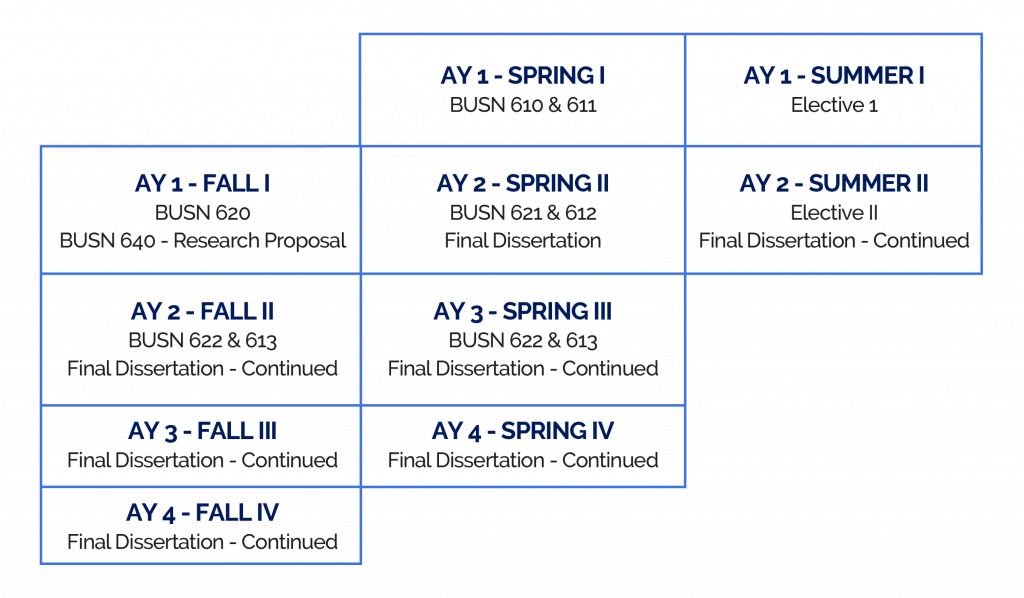
The program is designed to be completed within a minimum of
three years and a maximum of five years. During the first two years,
students focus on completing core and elective coursework. Upon
earning 9 credit hours, students become eligible to register for a
pre-dissertation course, during which they develop and submit
their research proposal. Once the proposal is successfully
defended, students may begin working on their final dissertation
while continuing to fulfill any remaining course requirements.
All candidates pursuing the DBA must complete a minimum of 60 credits with a cumulative GPA of 3.0 or higher. The structure of DBA program is based on 7 core requirement courses and 2 elective courses, each of 3 credits, plus a research proposal course of 9 credits, and a final dissertation of 24 credits. The program is designed to be completed within a minimum of
three years and a maximum of five years. During the first two years, students focus on completing core and elective coursework. Upon earning 9 credit hours, students become eligible to register for a pre-dissertation course, during which they develop and submit
their research proposal. Once the proposal is successfully defended, students may begin working on their final dissertation while continuing to fulfill any remaining course requirements.
Key Differentiators
PhD vs. DBA: How do they differ?
Program Highlights
Program Highlights
Program graduates will now receive a professional certification from the Digital Marketing Institute in Ireland (DMI) along with their academic degree.

Graduate Destinations











Career and Learning Progression
Career Progression
Graduates of the program can pursue careers in various fields, including:
- Social Media Marketing Specialist
- Digital Content Creator
- Search Engine Optimization Specialist
- Digital Marketing Analyst
- E-commerce Manager
- Creative Director
- Email Marketing Specialist
They are also equipped with a strong foundation that can help them progress to graduate courses within their field of study.
Learning Progression
Graduates holding a BBA in Digital Marketing and Social Media degree at AUBH have the flexibility to navigate various learning pathways in Digital Marketing and Social Media, based on their learned skills, interests, and strengths.
- Alongside holding the degree offered by the university, they will graduate with a professional degree (i.e., Certified Digital Marketing Associate) resulting from the university’s partnership with the Digital Marketing Institute (DMI).
- Upon graduation, they have the opportunity to study further to achieve DMI’s next professional certificate, the Certified Digital Marketing Professional qualification.
- They could also continue building their professional knowledge through a range of other qualifications from various awarding bodies such as the CIM (The Chartered Institute of Marketing) and the IPA (The Institute of Practitioners in Advertising), among others.
- Students may also choose to pursue post-graduate academic degrees, including an MBA degree (like the one offered by AUBH).
- They could pursue other master’s degrees in relevant areas of Digital Marketing including Analytics, Communication, Advertising, and Marketing Intelligence, either
Program Learning Outcomes
Upon successful completion of the program a graduate will be able to:
- Demonstrate critical understanding of the principles and concepts of digital and social media marketing, including relevant theories in associated fields of knowledge.
- Apply appropriate methods of digital and social media marketing research and create effective content and campaigns using industry standard software and platforms.
- Use qualitative and quantitative methods to analyze current and potential marketing and business-related problems facing an organization and recommend solutions.
- Use qualitative and quantitative methods to analyze current and potential marketing and business-related problems facing an organization and recommend solutions.
- Demonstrate effective oral and written communication skills, including the ability to develop coherent arguments in the context of the digital and social media marketing environment.
- Demonstrate the ability to work individually and collaboratively with team members and managers from other core business functions to address marketing and business needs.
- Demonstrate creativity and innovation in the planning, creation, and implementation of business and marketing strategies.
Program Requirements
| Program Name | Total Number of Credits |
|---|---|
| Bachelor of Business Administration in Digital Marketing & Social Media | 125 Credits |
Three-tiered Research Methods Sequence
A progressive sequence (Advanced Research Methods I–III) develops qualitative, quantitative, and mixed-methods expertise.
Contemporary Relevance
Courses in ethics, sustainability, governance, and emerging business topics prepare students for today’s global challenges.
Flexible Specialization
Electives in management, marketing, economics, and finance let students tailor the program to their career goals.
Integrated Research Pathway
From Applied Business Research to the Final Dissertation, the curriculum builds strong, evidence-based research skills.
Analytical Decision-making Focus
Modules and electives in decision-making, digital marketing, and global finance sharpen strategic and analytical skills.
Weekend Residencies
DBA students participate in one intensive weekend residency per course, Thursday to Saturday, twice during each Fall and Spring semester, and once in the Summer. This structure provides five in-person weekends per year, offering hands-on learning while maintaining a flexible schedule.
Related Programs
Department Contact Info
B.A. in Africana Studies
Contact:
Quick Facts :
- Tuition & Fees: BHD 19,800
- Total Credits: 84
- Completion Period: 3-5 Years
Quick Facts
Contact:
Proposed Semestrial Plan
Program Requirements
English Requirements (6 Credits)
This course develops reading and writing skills in Modern Standard Arabic with active speaking and listening skills in both formal Arabic and various Arabic dialects. Authentic materials from the Arabic media will be used in addition to text-related video and audio materials.
Prerequisites: None
ARHG 104: Arabic for Arabic Speakers (3 Credits)
A practical language course which aims at developing the language skills of native speakers of Arabic. This course provides the students with a comprehensive knowledge of the linguistic system. It is intended to help learners reach a superior level of proficiency by expanding vocabulary and providing paragraph-level activities in reading, writing, and speaking; through a selection texts by writers from across the Arab world address literary themes and represent a range of genres, styles, and periods, where each text is followed by exercises that measure understanding and comprehension, vocabulary and language applications, including grammar, morphology, spelling, stylistic applications and composition.
Prerequisites: None
ARHG 106: Modern History of Bahrain (2 Credits)
The course covers the Modern History of Bahrain since 1500 till 2002. It contains: Chapter I: Introduction geography. Chapter II: A Short History of Bahrain until the beginning of the sixteenth century. Chapter III: Bahrain between European and regional ambitions. Chapter IV: Utub tribe and the establishment of political entities in the Arabian Gulf. Chapter V of Bahrain and British protection. Chapter VI: Bahrain after independence.
Prerequisites: None
ARHG 107: Global Human Rights (2 Credits)
This course covers human rights historical development, major human rights laws, treaties and conventions. To learn obligations as citizens and residents of Bahrain as well as a member of the international community and to understand Human Rights Enforcement Mechanisms in Bahrain.
Prerequisites: None
ACCT 201: Introduction to Financial Accounting (3 Credits)
This course is an introduction to accounting and is required of all business majors. Its primary purpose is to give you an understanding of how and why accounting information is used from an external (financial reporting) and to some extent, internal (managerial reporting) perspective. Although the process of preparing accounting reports will be discussed, it is not the primary focus of this course. Instead, the focus will be on how accounting reports can facilitate decision making for a wide variety of individuals who are interested in and affected by the activities of a business .
Prerequisites: None
ACCT 202: Introduction to Managerial Accounting (3 Credits)
This introductory accounting course provides students with the knowledge of managerial accounting and its application in making economic decisions in a business entity. Topics covered will enable students to analyze and interpret both historical and estimated data by management to conduct daily operations, plan future operations and develop overall business strategies. As such, the emphasis will be on the use of accounting information for management purposes. Further developing analytical skills through problem solving and thoughtful participation in class as part of the preparation for a professional career is a major objective of this course.
Prerequisite: ACCT 201
BUSN 101: Introduction to Business (3 Credits)
This course introduces the fundamental principles of business organization, ownership, operation, and control.
Prerequisites: None
BUSN 301: Business Law (3 Credits)
This course is designed to provide learners with a study of the law governing the business environment, including the study of common law, statutory law and the role of legal institutions in regulating business activities. The course covers the topics of the American legal system, including civil litigation, intentional and unintentional torts, and the law of contracts. The course includes a general discussion of the legal system of Bahrain, in line with the course content.
Prerequisites: Minimum 60 credits
ECON 201: Principles of Microeconomics (3 Credits)
This class is an introduction to economics as it applies to the functioning of markets, businesses and households. Students learn how individuals make decisions about how to use scarce resources efficiently and how these decisions affect markets and the overall economy. Effect of government policies on the functioning of markets is also examined.
Pre-requisites: None
ECON 202: Principles of Macroeconomics (3 Credits)
This course introduces the analysis of a market economy. Emphasis will be on the measurement and determinants of aggregate economic performance, including output, income, employment, prices, interest rates, and economic growth. Consideration will be given to the role of the monetary and banking system, the Federal Reserve, government fiscal policy, and the global economy in influencing domestic business cycles, inflation and growth.
Pre-requisites: ECON 201
FINC 201: Essentials of Financial Analysis ( 3 Credits)
This course introduces the foundational knowledge in finance so that student can build skills and critically think about financial decisions made on a daily basis. The course begins with basic concepts, focusing on the economic environment (including financial markets, risk, the valuation process, and then shows how specific techniques and decision rules can be used to help maximize the value of the firm.
Prerequisites: ACCT 201
MGMT 101: Principles of Management (3 Credits)
This course explores the basic managerial functions of planning, organizing, leading, motivating, and controlling the contemporary environment.
Pre-requisites: None
MGMT 205: Organizational Behavior (3 Credits)
This course is an introduction to the basic concepts in management and organizational behavior. The course applies these concepts to the management of people and resources toward the accomplishment of organizational goals. Emphasis is placed on acquainting students with the literature and on understanding the relationship between theory and practice.
Prerequisite: MGMT 101
MGMT 350: Business Ethics (3 Credits)
This course introduces the ethical dimensions of business as related to the various stakeholders inside and outside the organization. Topics include business ethical theory, ethical decision making, typical dilemmas, and corporate social responsibility.
Corequisite: ENGL 205
Prerequisite: MGMT 205
MGMT 410: Business Policy and Strategic Management (3 Credits)
This course provides critical understanding of strategic management and business policies in modern organizations. This course is designed to develop problem-solving and decision-making skills in business situations that involve the organization as a whole and integrate knowledge and skills acquired from all areas of business.
Prerequisites: Minimum 75 credits, MGMT 101
MRKG 101: Principles of Marketing (3 Credits)
This is an introductory course in marketing. It examines the role of marketing within the organization and in society. Key marketing concepts include consumer needs, market research, pricing and promotion.
Pre-requisites: None
MSYS 201: Principles of Management Information Systems (3 Credits)
This course provides an overview of management information systems (MIS) and provides practical applications of Excel in the business environment. Course topics include components of MIS, IT infrastructure including hardware and software, networks and MIS security. The course also covers management, social and ethical issues relating to MIS, as well as basics of Excel as an information system.
Pre-requisites: None
DSGN 141: Computer Culture I (3 Credits)
This course provides an overview of the role of the computer within the subject of creativity. Course content introduces extensive knowledge about computers, information networks, multimedia environments and issues related to design and innovation processes that involve computers.
Prerequisites: None
MRKG 201: Consumer Behavior (3 Credits)
This course will help students understand how consumer behavior is central to the planning, development and implementation of marketing strategies. In addition to discussing classic consumer behavior concepts such as personality, perception, learning and attitude, this course will shed light on contemporary trends and issues including the role of new media, technological advances, and
recent ethical concerns affecting the marketing industry.
Prerequisites: MRKG 101
MRKG 202: Online Marketing Channels (3 Credits)
This course will help students understand how consumer behavior is central to the planning, development and implementation of marketing strategies. In addition to discussing classic consumer behavior concepts such as personality, perception, learning and attitude, this course will shed light on contemporary trends and issues including the role of new media, technological advances, and
recent ethical concerns affecting the marketing industry.
Prerequisites: MRKG 101
MRKG 302: Marketing Strategy and Planning in a Digital World (3 Credits)
The purpose of this course is to familiarize students with the process of developing and implementing a marketing strategy in a digital world. The course focuses on competitive positioning at the heart of marketing strategy and offers in-depth emphasis on the processes used in marketing to achieve competitive advantage. The course pays special attention to the role of digital marketing tools in informing digital marketing strategy and planning.
Prerequisites: MRKG 101, MRKG 202, Minimum 60 credits
MRKG 401: Principles of Marketing Research (3 Credits)
The purpose of this course is to familiarize students with the key challenges facing marketing researchers in a modern world. The course will introduce students to the transactional stages of marketing research, including problem definition, research design development, data collection and analysis, and communication of research findings. It will further teach students to apply research findings to current marketing challenges.
Prerequisites: Minimum 70 credits, MATH 115
MRKG 421: Data Analytics and Visualization (3 Credits)
The purpose of this course is to enable students to acquire critical knowledge and understanding of digital marketing analytics and its impact on marketing strategy and planning. Students will be able to critically analyse marketing data and use specialist tools to make informed marketing decisions.
Prerequisites: MRKG 101, MRKG 202, Minimum 60 credits
MRKG 431: Contemporary Issues in Social Media Campaigns (3 Credits)
The purpose of this course is to teach students about the latest developments in social media marketing research and practice. This will be achieved by presenting a balance of essential theory and practical applications in the field of social media campaigns in the 21st century.
Prerequisites: MRKG 101, MRKG 202, Minimum 60 credits
MRKG 480: Marketing Internship (3 Credits)
The purpose of the Internship subject is to provide students with opportunity to demonstrate the application of conceptual knowledge to the real world via industry placement in their selected field. This allows students to integrate their theoretical and conceptual knowledge with the skills and problem-solving techniques required in the workplace. Other outcomes include the acquisition of knowledge, research skills and the attitudes of business professionals, the ability to think independently, grow in originality, creativity, initiative, curiosity, enthusiasm, and resourcefulness, the ability to communicate ideas, an understanding of theory and procedures; knowledge of pertinent literature; and adeptness in the workplace. This subject provides a valuable transition between university and the workplace.
Prerequisites: Minimum 90 credits, CGPA of 2.00, MRKG 101, MGMT 101, FINC 201.
MRKG 499: Capstone Project (6 Credits)
This course is designed for final year digital marketing and social media students to further their digital marketing knowledge and skills. As they take this course, students will research and present solutions to a real-world digital marketing problem. This course encourages students to think analytically, logically, and creatively to integrate experience and knowledge in real world digital and social media marketing situations.
Prerequisites: MRKG
401, CGPA of 2.00,
Minimum of 90 credits.
MGMT 430: Project Management 3 Credits)
This course will give you the basic skills of project management with an emphasis on the creative industries (design, media etc.). You will acquire the technical tools to plan, estimate resources and pilot the progress of the project. Additionally, you will get a practical overview of the human aspects of project management.
Prerequisites: FINC 201,
ACCT 202, ENGL 205,
Minimum 70 credits
BUSN 410: Artificial Intelligence for Business (3 Credits)
This course aims to provide students with critical knowledge and experience to identify opportunities in proposing and deploying AI solutions to real business scenarios. Having successfully completed the course, students will be able to describe AI and the role it can play to deliver benefits for businesses, identify potential applications of AI in practice, and assess the main capabilities of AI and the core technologies that help deliver them.
Prerequisites: MATH 115 or MATH 153, ENGL 102, COSC 101 or MSYS 201; Minimum 60 credits.
DSGN 301 Web Design (3 Credits)
This course is a survey of the key design elements of publishing content on the World Wide Web. Course content includes processes such as concept development for interactive design works, information design, interface design, interaction design, optimization and integration for the Web, usability, beta-testing, etc., as well as the basic principles of publishing and managing visual content for hypermedia and an interactive portal site. Tools for creating and editing Web projects include browsers, browser helper applications, HTML editors, document management tools and image editors.
Prerequisites: Minimum 60 credits
MGMT 305: International Business (3 Credits)
This course reviews the principles, tools, processes, and practices used by managers to understand international markets, cultures, economies and political environments and to achieve competitive advantage in an international setting. Topics covered include globalization, country differences (political, economic, legal, and cultural), global trade and investment, global monetary systems, strategy and structure of international businesses, and international business operations and practices.
Prerequisite: MGMT 205, ECON 202.
MGMT 313: Managing Change and Innovation (3 Credits)
This course explores the importance of innovation to business success and considers current trends in technology, society, consumer expectations and the workforce. The course includes examination of strategies for enabling innovation and overcoming obstacles to change. The course content also presents the concept of a learning organization in the context of transformational leadership.
Prerequisites: MGMT 205
MGMT 403: Entrepreneurship (3 Credits)
This course introduces the fundamentals for starting any business with some empirical guidance on how to use the tools and resources to start a new technology venture that is relevant and can be competitive in the marketplace.
Pre-requisites: MGMT 101, Minimum of 60 Credit
MRKG 310: Integrated Marketing Communications in a Digital World (3 Credits)
The purpose of this course is to familiarize students with an evolved definition of integrated marketing communications (IMC) and teach them how to effectively communicate in the business world. It will help students understand the importance of weaving together all marketing activities into one clear message and voice and how communications are produced and transmitted in a digital world. The subject additionally explores advertising and promotions, and the roles of social media, and other marketing tactics to effectively reach consumers.
Prerequisites: MRKG 101, minimum 60 credits
MRKG 410: Services Marketing (3 Credits)
The purpose of this course is to enable students to acquire critical knowledge and understanding about the vital role that services play in the economy and its future and how services dominate the advanced economies of the world. This course will also cover implementing service strategies for competitive advantage across industries.
Prerequisites: MRKG 201, Minimum of 60 Credits
ARHG 101: Arabic for Non-Arabic Speakers (3 Credits)
This course develops reading and writing skills in Modern Standard Arabic with active speaking and listening skills in both formal Arabic and various Arabic dialects. Authentic materials from the Arabic media will be used in addition to text-related video and audio materials.
Prerequisites: None
ARHG 104: Arabic for Arabic Speakers (3 Credits)
A practical language course which aims at developing the language skills of native speakers of Arabic. This course provides the students with a comprehensive knowledge of the linguistic system. It is intended to help learners reach a superior level of proficiency by expanding vocabulary and providing paragraph-level activities in reading, writing, and speaking; through a selection texts by writers from across the Arab world address literary themes and represent a range of genres, styles, and periods, where each text is followed by exercises that measure understanding and comprehension, vocabulary and language applications, including grammar, morphology, spelling, stylistic applications and composition.
Prerequisites: None
ARHG 106: Modern History of Bahrain (2 Credits)
The course covers the Modern History of Bahrain since 1500 till 2002. It contains: Chapter I: Introduction geography. Chapter II: A Short History of Bahrain until the beginning of the sixteenth century. Chapter III: Bahrain between European and regional ambitions. Chapter IV: Utub tribe and the establishment of political entities in the Arabian Gulf. Chapter V of Bahrain and British protection. Chapter VI: Bahrain after independence.
Prerequisites: None
ARHG 107: Global Human Rights (2 Credits)
This course covers human rights historical development, major human rights laws, treaties and conventions. To learn obligations as citizens and residents of Bahrain as well as a member of the international community and to understand Human Rights Enforcement Mechanisms in Bahrain.
Prerequisites: None
Core Requirements & Electives (27 Credits)
Major Requirements
- BUSN 610 Applied Business Research (3 credits)
- BUSN 620 Advanced Research Methods I (3 credits)
- BUSN 621 Advanced Research Methods II (3 credits)
- BUSN 622 Advanced Research Methods III (3 credits)
- BUSN 611 Ethics, Sustainability and Governance (3 credits)
- BUSN 612 Managerial Decision Making (3 credits)
- BUSN 613 Contemporary Topics in Business (3 credits)
Elective Courses
- MGMT 630 Organizational Theory and Design (3 credits)
- MRKG 630 Digital Marketing Strategy and Analytics (3 credits)
- ECON 630 Advance Managerial Economics and Business Strategy (3 credits)
Pre-dissertation Course (9 Credits)
- BUSN 640 Research Proposal (9 credits)
Dissertation Course (24 Credits)
- BUSN 650 Final Dissertation (24 credits)
Admission Criteria
- Hold a Master’s degree from an accredited institution of higher education.
- Maintain a minimum CGPA of 3.00 and above or equivalent. Applicants with a CGPA of 2.7 or above
and relevant work experience of three years or more may also be considered for entry. - English language proficiency score of 6.5 in the IELTS or equivalent with no less than 6 in the
writing component. Applicants will be exempted from this requirement if they are citizens of a country where their first language is English (such as the UK, USA, or Canada); or hold a Master’s degree awarded from one of those countries. - A personal interview may be conducted if necessary.
Applicants will be required to submit an initial research proposal outlining their area of interest and participate in an interview with an academic representative from the college. While the university will make every effort to accept all eligible applicants, due to the broad scope of DBA research topics, admission will be based on the alignment between the applicant’s research focus and the available supervision expertise. This approach ensures that students receive the highest level of support throughout their studies.
To apply for the Doctorate degree programs, applicants must meet the following criteria:
- Hold a Master’s degree from an accredited institution of higher education.
- Maintain a minimum CGPA of 3.00 and above or equivalent. Applicants with a CGPA of 2.7 or above and relevant work experience of three years or more may also be considered for entry.
- English language proficiency score of 6.5 in the IELTS or equivalent with no less than 6 in the writing component. Applicants will be exempted from this requirement if they are citizens of a country where their first language is English (such as the UK, USA, or Canada); or hold a Master’s degree awarded from one of those countries.
- A personal interview may be conducted if necessary.
Research Supervisors

Dr Ahmad Alhaiki
Finance

Dr Amal Ahmadi
Leadership

Prof. Hanan Naser
Economics

Dr Fatema Alaali
Economics

Dr Layla Mohammed
Science, Technology and Innovation Policy- EVs

Dr Maryam Almahdi
Digital Marketing

Dr Miriam Al Lily
Economics
Research Supervisors
Dr Ahmad Alhaiki
Finance
Dr Amal Ahmadi
Leadership
Prof. Hanan Naser
Economics
Dr Fatema Alaali
Economics
Dr Layla Mohammed
Science, Technology and Innovation Policy- EVs
Dr Maryam Almahdi
Digital Marketing
Dr Miriam Al Lily
Economics
Connect
Campus Life
At AUBH, we understand that life outside of study is as important as academic performance. We provide our students with a well-rounded university experience that is on a par with experiences abroad.
Admissions
Apply Now
Celebrating a quality American-model University education, created for students from Bahrain and across the Gulf who share a common goal of success on the world stage.
Student Testimonials

I would highly recommend Michael Richard to anyone interested the subject matter. It has provided me with invaluable knowledge & a newfound passion topic. My only suggestion would be to add more live.

Testimonial Name
Designation
I would highly recommend Michael Richard to anyone interested the subject matter. It has provided me with invaluable knowledge & a newfound passion topic. My only suggestion would be to add more live.
Testimonial Name
Designation
I would highly recommend Michael Richard to anyone interested the subject matter. It has provided me with invaluable knowledge & a newfound passion topic. My only suggestion would be to add more live.
Testimonial Name
Designation